
Property Listings Inside Google Search? Why This Test Could Reshape Real Estate Marketing
Are we about to see property listings appear directly within Google search results? It is something users are already familiar with in other industries. Hotels, flights, and product listings frequently appear at the top of Google, but property listings have traditionally remained outside this space. That may soon be changing.
Google is currently testing a new format that displays property listings directly in the search results. These listings include images, property descriptions, agent information, and even the option to request a viewing without leaving Google. If rolled out more widely, this would represent a major shift in how users search for and engage with property online.
If this test were expanded into other markets such as Spain, it would be a genuine game changer for the real estate sector.
A Paid Partnership, Not Organic Search
It is important to be clear about what this test is, and what it is not. The listings shown in Google’s test are not pulled from agents’ own websites and they are not organic search results.
Instead, they form part of a paid partnership between Google and a US-based property aggregator called ComeHome. The listings are clearly labelled as a curated commercial unit rather than traditional organic results. This strongly suggests that Google is experimenting with a new paid search format specifically designed for property listings.
For agents and developers, this distinction matters. Visibility within these listings would depend on data partnerships and paid placement, not SEO performance.
How the Test Works Today
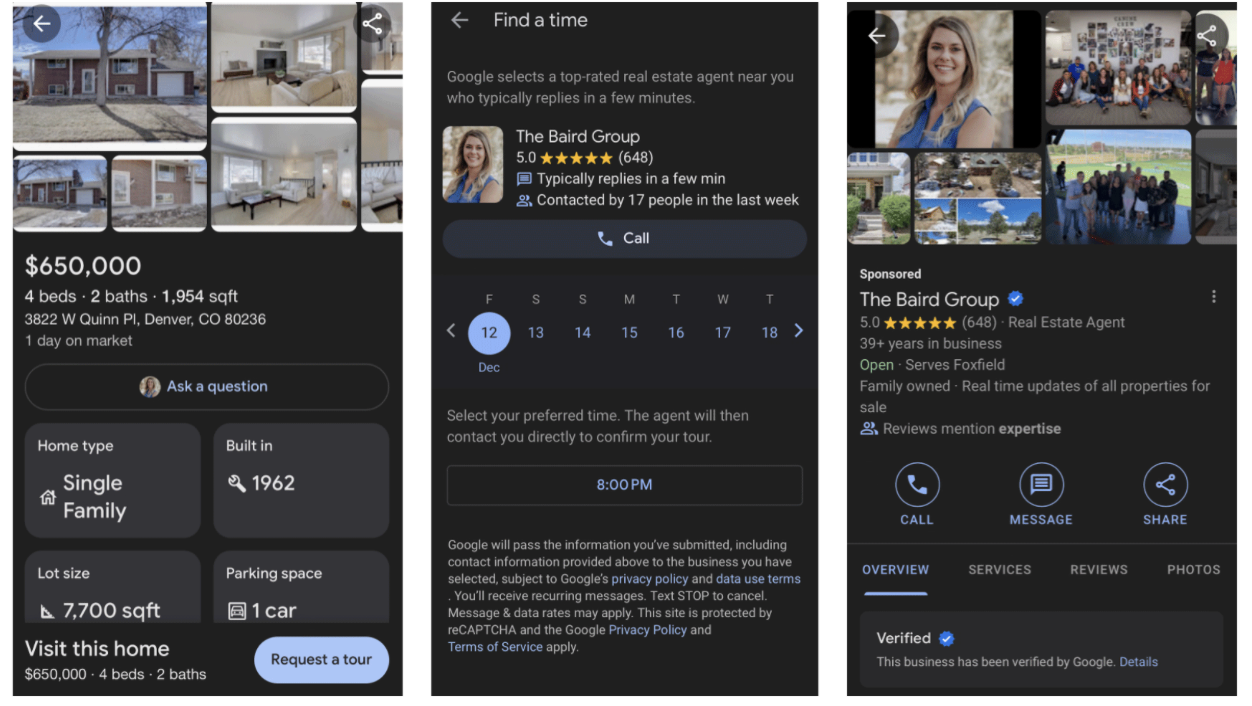
(Image from https://www.mikedp.com/articles/2025/12/12/google-enters-the-portal-wars )
At present, the test is limited in scope. It is only available on mobile devices and only in selected US markets such as Chicago, Los Angeles, and Dallas. The listings are triggered by property-focused searches such as “homes for sale” and appear in a carousel format that closely resembles a property portal.
ComeHome provides access to MLS data, allowing Google to display live property listings directly within the search results. If Google were to expand this globally, it would need equivalent data sources in other regions.
This raises important questions. Agents who do not use an MLS, or who rely on alternative listing systems, could be excluded altogether. Even agents who do use an MLS would have no guarantee that their provider would be included in any future rollout. At this stage, the test creates as many uncertainties as it does opportunities.
Not Live in Europe Yet, but Not Something to Ignore
There is no official confirmation that it will be rolled out beyond the US. However, this does not mean European agencies and developers should dismiss it.
Google has a long history of launching and refining new search features in the US before introducing them into European markets. Many of the changes that now shape SEO, paid search, and lead generation strategies in Europe were first tested and proven in North America.
If property listings were to appear directly in Google search results across Europe, the impact would be significant. Competition for visibility would intensify, reliance on traditional portals could reduce, and user behaviour would shift towards interacting directly within Google rather than clicking through to third-party platforms.
For real estate brands, this reinforces the importance of staying proactive. Agencies that monitor these developments early are far better placed to adapt than those who wait until changes are already established.
A Direct Challenge to Property Portals
This test represents a clear threat to established property portals such as Zillow in the US and Idealista in Spain. These platforms have historically been the primary destination for users searching for properties for sale.
When news of the test became public, Zillow’s share price dropped sharply, with similar reactions seen across other portal-based businesses. This response reflects investor concern that Google could disrupt the traditional portal-driven real estate model.
Google’s broader strategy supports this concern. Over time, the search engine has evolved to keep users within its own ecosystem. Weather forecasts, currency conversions, and AI-generated answers now appear directly in search results. With AI Overviews reducing the need to visit external websites, property listings shown directly in Google could satisfy user intent without any click-through at all.
If users can browse properties and contact agents directly from search results, portals may see a decline in organic traffic, with fewer measurable visits and enquiries taking place on their platforms.
What This Means for Real Estate Marketing
While this appears to be a paid search experiment rather than an organic update, the implications are far-reaching. If Google continues to develop this format, real estate lead generation strategies will need to evolve.
Data access, paid visibility, and platform dependency will become increasingly important considerations. Agencies and developers will need to think carefully about how they balance portal exposure, paid media, and direct lead generation through their own channels.
At Manifesto, we see this as another signal that real estate marketing is becoming more competitive and more platform-driven. Staying informed, flexible, and strategically prepared is no longer optional.
Final Thoughts
Google’s property listings test may still be in its early stages, but its potential impact is clear. If rolled out beyond the US, it could reshape how buyers discover properties, how agents generate leads, and how portals maintain their relevance.
For now, it is a development worth watching closely. For the future, it is a reminder that those who stay ahead of platform changes are the ones best positioned to benefit from them.
At Manifesto, we will continue to monitor this test and share insights as the situation evolves.